
Eligibility navigators
Your staff know how the system works. Families can't get at it.
The eligibility knowledge in your program staff's heads, turned into a guided tool your families can use on their own.
The problem
Benefits eligibility is genuinely hard. Not confusing-website hard. Structurally hard.
The rules live across Medicaid waiver applications, state administrative code, provider manuals, and managed care bulletins. They change every legislative session. They vary by county and by plan.
Your staff have learned it anyway. That's the problem.
The same fifteen questions, every week.
Intake takes time you don't have, and it doesn't scale with demand.
One retirement from losing it.
When a veteran program director leaves, twenty years of eligibility knowledge goes with them.
Underneath all of it
Nobody on your staff wants to be the person who told a family they qualified when they didn't.
That fear is the single biggest reason organizations don't build this themselves. It's a reasonable fear. I designed around it.
Built in North Carolina
Community Workforce Solutions — Raleigh
CWS serves families of young adults with intellectual and developmental differences. Their staff know North Carolina's system as well as anyone in the state, and that knowledge was reaching only the families who made it into the room.
I built a guided tool that helps families identify NC Medicaid programs and services they may qualify for, with plain-English guidance on how to apply.
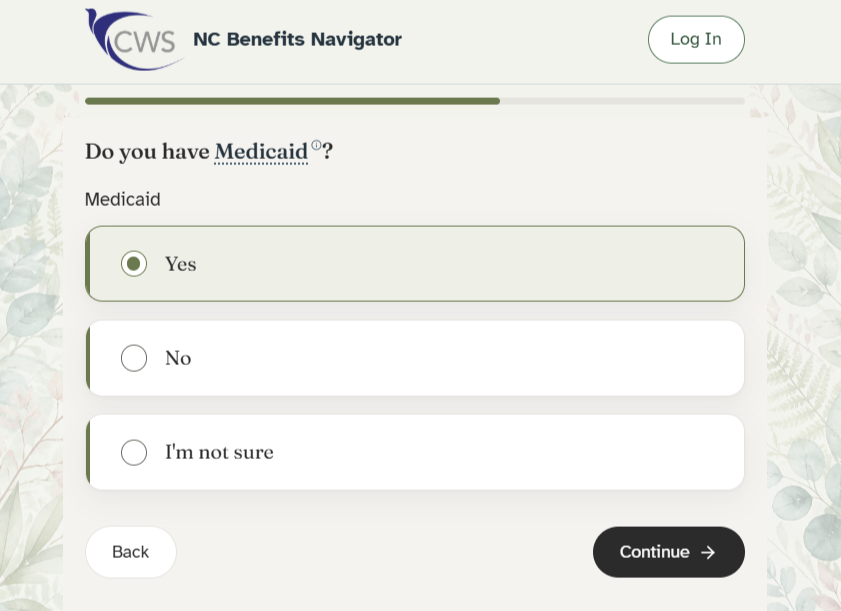
What the work produced
A documented eligibility model, extracted from their domain expert
A schema separating programs, funding sources, and eligibility conditions
A matching engine with the safety rules built into the logic layer
An admin interface their staff maintain themselves
Most people assume this is an AI reading North Carolina's Medicaid website. It isn't.
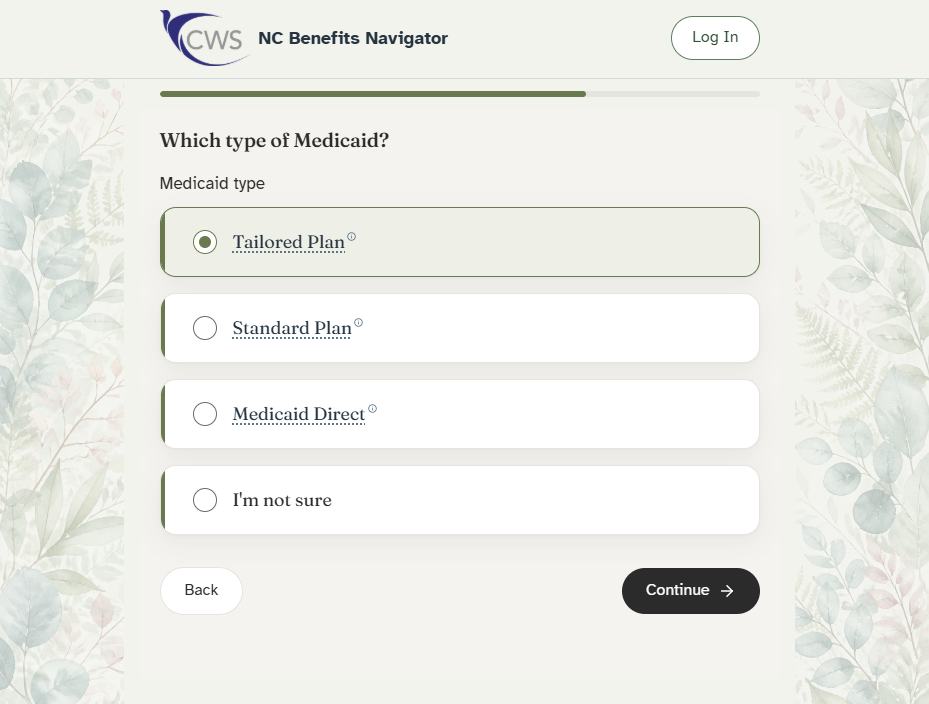
The decisive insight was that funding source — not diagnosis — is the primary filter, and that Medicaid has to be tracked at the plan level rather than as one category. That isn't written down in any document. It came out of a program director's head, built from twenty years of cases.
So the work isn't research. It's extraction.
“Our rules are different from North Carolina's.”
They will be. The method is what carries over, not the content. Your programs, your funding sources, your conditions — extracted fresh and validated by your staff.
See How It Was Built
What you get
A web tool that asks a short series of questions and tells a family, in plain English, which programs they may qualify for.
Written for a stressed parent on a phone.
Not for a caseworker. Plain language, no jargon, works on any device.
Built on your logic, not mine.
Every eligibility rule comes from your domain expert and gets your sign-off before it ships.
Yours to maintain.
Staff update programs and rules through an admin interface. No developer, no support ticket, no waiting on me.
Something to report.
Anonymized usage data turns "we held twelve workshops" into a reach number a funder can read.
The process
Four steps. Nothing ships without your sign-off.
Sessions with your expert
Structured conversations with whoever on your staff actually knows this. I map every "well, it depends" back to the variable that decides it.
A documented model
Your eligibility logic, written down and validated — a real asset whether or not you ever build a tool.
Your review
Nothing ships without your sign-off. Not one rule.
The tool
Question flow, results, application guidance, admin interface, staff training.
Built to be safe
Four principles, enforced in the system itself rather than in the wording.
01
It never says a family is eligible.
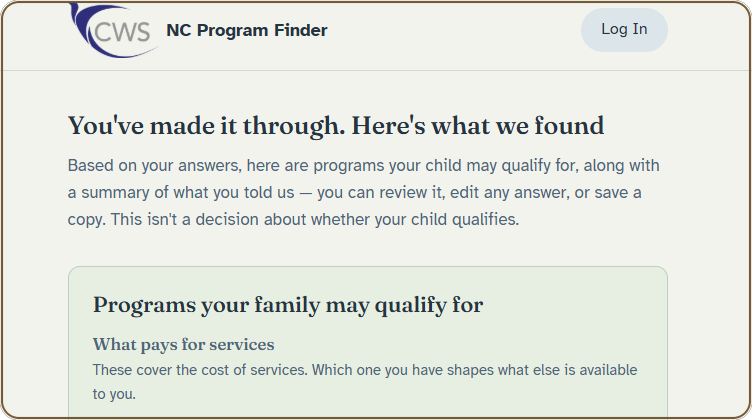
Always "may qualify." That's built into the logic, not the copy.
02
Uncertainty widens results.
A "not sure" answer returns more options with caveats — never a dead end.
03
The eligibility logic belongs to you.
You own it. You approve it. You can take it with you.
04
Every claim is sourced and dated.
Rules change. You'll always know where a rule came from and when it was last checked.
A wrong referral costs a family an appointment they couldn't afford, and it costs you credibility. If your board is going to ask hard questions about liability, these are the four answers. They should ask.
Ways to start
Most organizations start small. That's the right instinct.
One week
Eligibility Logic Assessment
$1,600
Two sessions with your domain expert, and a short written diagnostic: where your knowledge is concentrated, which determinations carry the most risk, and what a full build would involve. You get a real document either way. Most Executive Directors can approve this without a board vote.
Four to five weeks
Knowledge Extraction Sprint
$2,000–$4,000
Your complete eligibility logic, documented and validated. You own it outright. It has value on its own — for training, for continuity planning, for a grant application — whether or not you build anything.
Sixteen to twenty weeks
Navigator Build
$6,000–$8,000
The full tool: extraction, schema, matching engine, front end, admin interface, staff training. Fixed fee, scoped to be written into a grant.
Ongoing maintenance
Rules change every session. Your staff handle day-to-day updates through the admin interface; larger changes — a new waiver, a restructured plan — are what maintenance covers. It's best written into the original grant request rather than found later, and I'll help you scope it that way.
Please contact me for specialized rates.
Questions
What Executive Directors ask first.
Who you'd work with
Seasoned AI is Paul Hilburger.
Twenty years in user experience design, most of it making complicated systems usable by people who didn't ask to learn them. Eight U.S. patents. Before that, film production.
I've also navigated these systems as a parent.
That combination is the whole reason this works. The hard part isn't the software. It's getting knowledge out of an expert's head without flattening it, and then writing it so a parent at 11pm on a phone can act on it.
I work with a small number of organizations at a time. That's deliberate — in a sector this small, one careless engagement is a reputation.

“The hard part isn't the software. It's getting knowledge out of an expert's head without flattening it.”
— Paul Hilburger, Seasoned AI
Start a conversation
Twenty minutes, no pitch deck.
Tell me what your staff spend their time answering, and I'll tell you honestly whether this is worth your money.
If it isn't, I'll say so.
Serving organizations in North Carolina and the Southeast.